


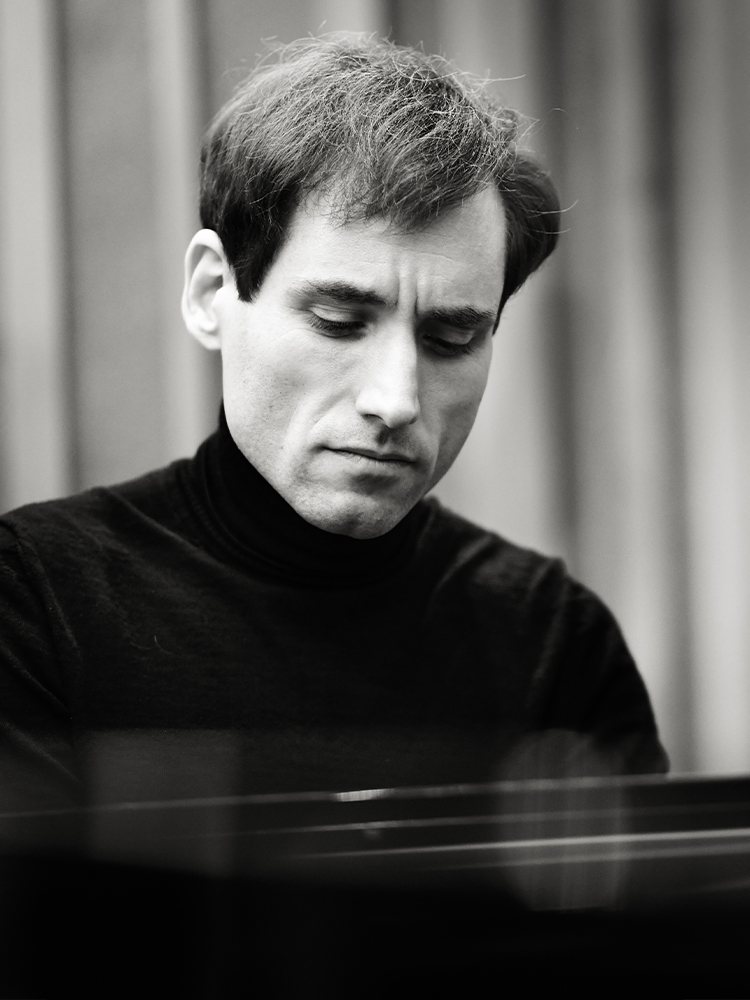
Israeli pianist Boris Giltburg is lauded across the globe as a deeply sensitive, insightful and compelling interpreter for his narrative-driven approach to performance.
Giltburg’s long list of orchestral collaborators extends to the Czech Philharmonic, Orchestra dell’Accademia Nazionale di Santa Cecilia, Finnish Radio Symphony, Orchestre National de France, Oslo Philharmonic, Philharmonia Orchestra, NHK Symphony and Seoul Philharmonic, among others.
Giltburg regularly gives recitals in the world’s most prestigious halls, including Concertgebouw, Amsterdam; BOZAR, Brussels; Elbphilharmonie, Hamburg; Southbank Centre and Wigmore Hall, London; Carnegie Hall, New York; Rudolfinum, Prague; and Konzerthaus, Vienna. Following the success of his Beethoven Piano Sonatas cycle across eight sold-out concerts at the Wigmore Hall, he continues the project at Flagey, Brussels, Palau de la Música, Valencia and Teatro Municipal in Santiago de Chile. In recent years Giltburg has also engaged in a series of in-depth explorations of other major composers such as Ravel and Chopin.
Giltburg is widely recognized as a leading interpreter of Rachmaninov. This season sees Giltburg perform the complete Rachmaninov Preludes during the opening weekend of the Southbank Centre’s 25/26 season and Rachmaninov’s 3rd Piano Concerto with the Philharmonia Orchestra at Bold Tendencies. In 2025 Giltburg released an album of Rachmaninov’s landmark Piano Sonatas nos. 1 and 2 alongside his own version of The Isle of the Dead.
A consummate recording artist, Giltburg has recorded exclusively for Naxos since 2015. He was awarded the Opus Klassik Award for Best Soloist Recording of Rachmaninov’s concerti and Etudes Tableaux and a Diapason d’Or for Shostakovich concerti and his own arrangement of Shostakovich’s Eighth String Quartet. Among others, he has won a Gramophone Award for the Dvořák Piano Quintet with the Pavel Haas Quartet, as well as a Diapason d’Or and Choc de Classica for their joint release of the Brahms Piano Quintet.
Giltburg feels a strong urge to engage audiences beyond the concert hall. His blog “Classical Music for All” is aimed at a non-specialist audience, which he complements with articles in publications such as Gramophone, BBC Music Magazine, The Guardian and The Times.
 Back to top